
Advancing Sustainable Manufacturing for the Green Economy
The Programme
The BioCoLiDe project is implemented under the PhD in Industry programme of the Research and Innovation Foundation (RIF), within Pillar II – Sustainable RTDI System.
Project Code: PHD IN INDUSTRY/1124/0007
Implementation Duration
Project Framework: PhD in Industry, Research and Innovation Foundation (RIF)
Host Organisation: Nicolaides & Kountouris Metal Company Ltd (NKMC), in collaboration with Frederick University as the academic partner.
Target Completion: June 2029

The Project
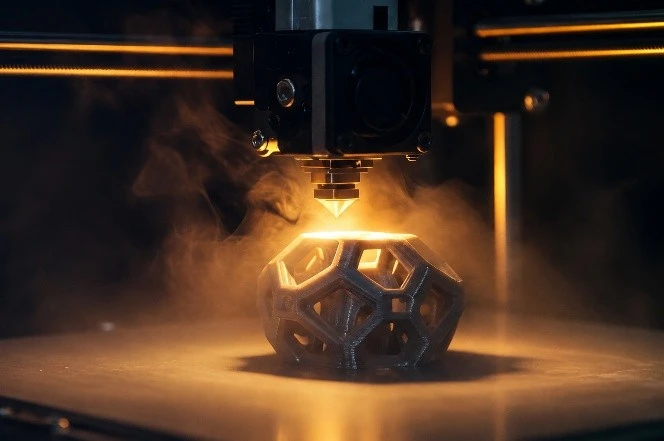
BioCoLiDe is a research and innovation project focused on the development of sustainable, bio-based composite materials using recycled polymers and natural fibres. Through the application of Liquid Deposition Modelling (LDM) technology, the project aims to create high-performance materials for thermal insulation and semi-structural applications, bridging scientific research with industrial implementation while promoting circular economy principles.
Mission & Vision
Mission
To develop innovative, environmentally friendly composite materials that reduce environmental impact while delivering high performance for industrial and construction applications.
Vision
To accelerate the transition towards sustainable manufacturing by combining advanced technologies, circular material use, and strong collaboration between academia and industry.
Project Partners
CoLiDe is a collaborative research project between Frederick University and Nicolaides & Kountouris Metal Company Ltd (NK Metal). The partnership combines academic research with industrial expertise to develop sustainable composite materials with real-world applications for the construction industry.

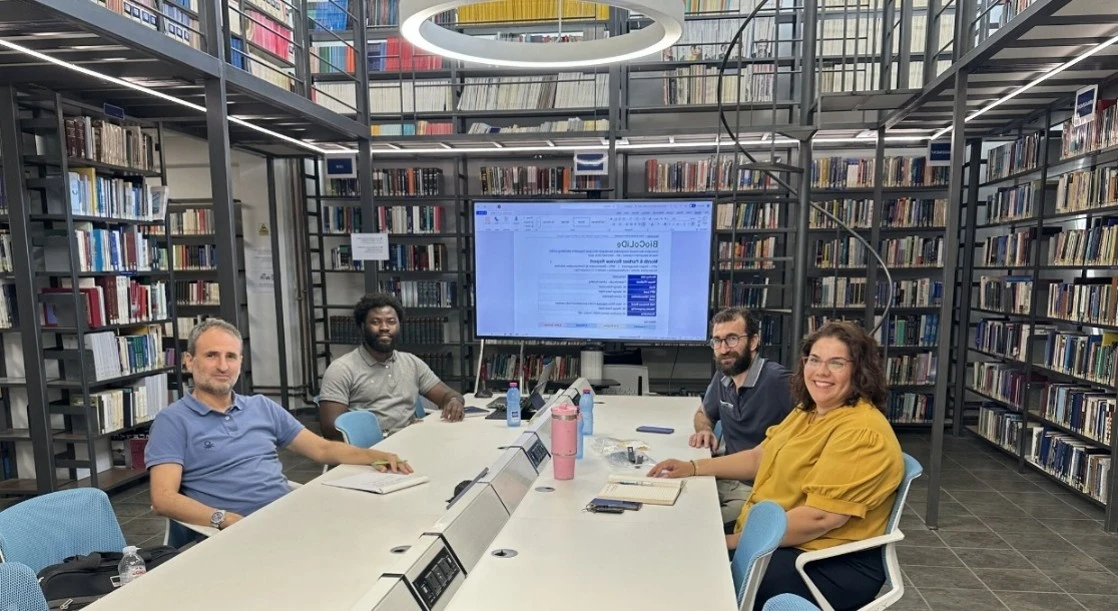
The BioCoLiDe project team during a meeting under the PhD in Industry programme: PhD researcher Mr Tobi Kadiri, Antonis Kountouris from Nicolaides & Kountouris Metal Company Ltd (NKMC), and Loucas Papadakis and Maria Rikkou-Kalourkoti from Frederick University.
Material Innovation
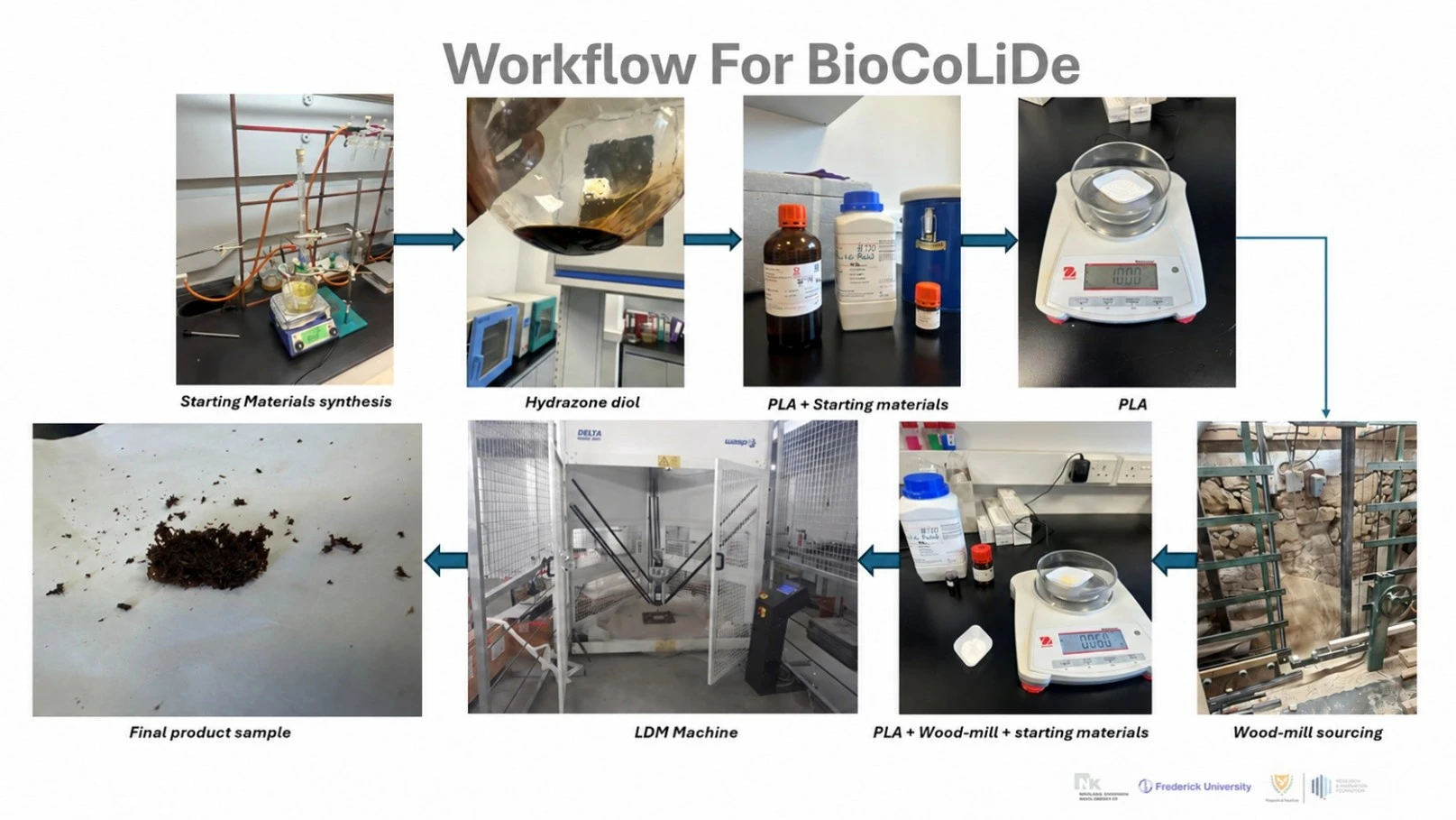
At the core of BioCoLiDe is a chemically modified recycled PLA system. The base polymer is enhanced through the addition of itaconic acid (IA), a bio-derived building block, and a hydrazone-bearing diol (HBD), which together improve the material’s processability and mechanical properties. This modified PLA is then reinforced with natural fibres — flax, jute, and hemp — to further boost strength and stiffness while keeping the material bio-based.
The resulting composite is processed using Liquid Deposition Modelling (LDM), an advanced additive manufacturing technique that allows precise, layer-by-layer fabrication of components directly from the material formulation — bridging laboratory-scale material science with practical, industrial-scale production.
Innovation & Advantages
- Converts recycled plastic waste into a high-value engineering material
- Reduces dependence on virgin plastics and non-renewable resources
- Combines natural fibre reinforcement with bio-based chemical modification for improved performance
- Enables direct, on-demand manufacturing of components via LDM
- Supports circular economy principles across the material lifecycle
- Targets real-world applications in thermal insulation and semi-structural construction elements
- Strengthens the link between academic research and industrial application